
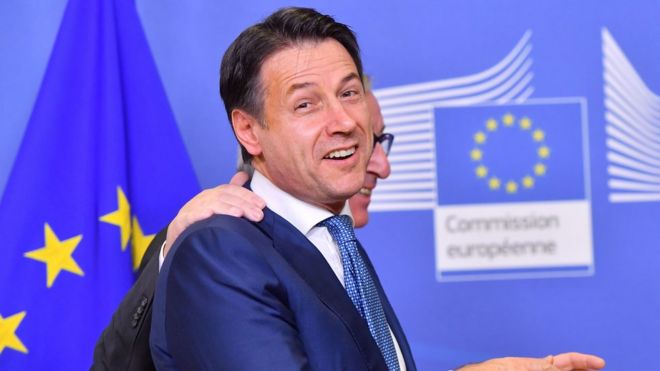
Italy looks set to defuse a row with the EU after weeks of publicly defying officials in Brussels over its high-spending budget plans.
Its leaders wanted to "end poverty", raising the deficit to 2.4% of GDP.
But in an unprecedented move, the European Commission said they should revise the budget and tackle debt.
Deputy Prime Minister Luigi Di Maio said on Monday his government might be willing to reduce the deficit target to end the standoff.
"If, during the negotiating process, the deficit has to be reduced a bit, that's not a big deal," Mr Di Maio said.
Italy's draft budget contains expensive measures for introducing a guaranteed basic income of about €780 (£700) for poor families, and raising the retirement age.
"The important thing is that not one person misses out on the (pledged) measures," Mr Di Maio added.
The apparent change of mind followed a weekend meeting in Brussels between Italian Prime Minister Giuseppe Conte and European Commission President Jean-Claude Juncker.
Italian media were on Monday morning reporting that the deficit could be slashed from 2.4% to 2.2% of GDP - but government sources quoted by Reuters suggested the deficit could be reduced to as low as 2%.
The revelations prompted share prices in Milan to soar, while a keenly watched measure of economic turmoil in Italy, the "spread" between Italian and German bond prices, fell to 280 points amid expectations of a resolution to the crisis.
- Italy's populists agree new budget
- Italy defies EU demand to cut budget
- EU rejects debt-hit Italy's budget
A meeting to discuss the details was scheduled for Monday evening.
But it was not clear how any reduction in spending would be financed if key election promises made by the ruling populist League and Five Star parties remained untouched. Nor was it certain that the changes would be enough to satisfy the European Commission.
Matteo Salvini, the joint deputy PM and leader of the League, had already hinted at change on Sunday, saying "no-one is stuck" at a specific number for the deficit.
Giuseppe Conte told Italy's Ansa news agency "I do not talk about decimals", and argued it was more important to assess the wider economic impact of the proposed reforms.
'Sleepwalking into instability'
The Commission announced last Wednesday that Italy was "sleepwalking into instability" and that opening a case under the eurozone's "excessive deficit procedure" was now on the cards.
Fines under that procedure could start at 0.2% of Italy's entire GDP - which would measure in the billions of euros.
The reason for Europe's concern is that while Italy is the third-largest economy in the eurozone, with a GDP of more than two trillion euro, it also has a large amount of debt.
Eurozone rules say that countries should both keep their deficit to less than 3% of GDP - which Italy's plans do - but also keep national debt to 60% of GDP or less.
Many countries exceed that debt limit without any action being taken. But at almost 132% of GDP, Italy has the second highest rate in the bloc.
When Brussels received Italy's draft budget, it said the country's refusal to deal with its debt and essentially triple the planned deficit was unacceptable.
Italy, meanwhile, maintained that investment was needed to kick-start the sluggish Italian economy and reduce the suffering of its citizens.
Italy budget: Rome set to back down in EU row
By Hyan Furtado

Pubs are employing more people than 10 years ago, despite almost a quarter of them having closed over the same period, official figures show.
According to research by the Office for National Statistics (ONS) this could be because an increasing number now serve food, which is more labour intensive.
More than 11,000 pubs have closed, leaving around 39,000 across the UK, the ONS said.
Some areas on the edges of big cities have seen pub numbers halve since 2001.
Low pay
The ONS found that the number of jobs in pubs dipped during the economic downturn. However, employment in the sector picked up subsequently and there are now 6% more jobs in pubs and bars than there were in 2008.
The largest increases have been in bigger pubs (those with 10 or more employees). This may be because serving food requires more waiting and kitchen staff.
- Pubs closing at rate of 18 a week
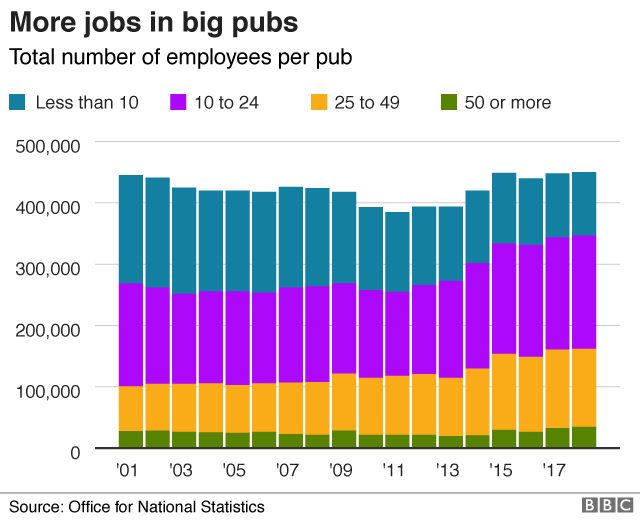
The rise in employment has been more pronounced in rural pubs, where in 2018 total employment in England and Wales is 17% higher compared with 2008. In contrast, employment in urban pubs rose by only 4% over the same period.
But most jobs in the sector are low paid with around 70% of workers in pubs and bars being paid less than the Living Wage Foundation's recommended Living Wage. This is set at £10.55 per hour in London and £9 per hour elsewhere.
The ONS's analysis shows it is small pubs that are disappearing, while the bigger chains are consolidating around larger bars.
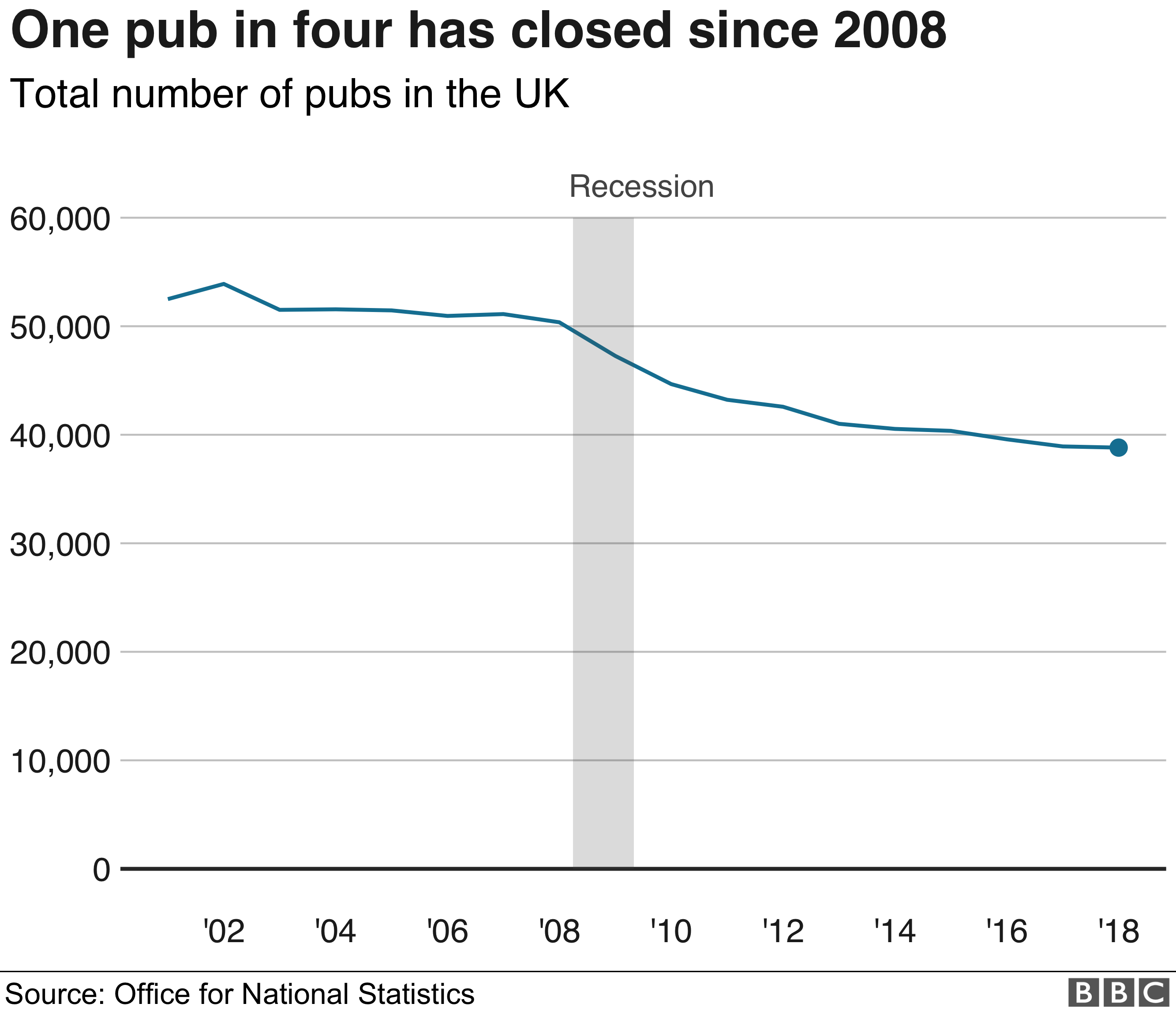
The closure of British pubs is a well-known story. Organisations such as the Campaign for Real Ale and the British Beer and Pub Association have charted the disappearance of pubs for many years, citing reasons including rising overheads, the smoking ban and the rise of cheaper alcohol sold in supermarkets.
Barking and Dagenham, Newham and Luton - all in and around London - now have fewer than half the pubs they did in 2001.
There are far fewer pubs in some towns around Manchester, including Burnley, Bolton and Rochdale, as well as on the outskirts of Birmingham, in areas including Sandwell, Dudley and Walsall.
On the other hand, locations popular with tourists, including the Highlands of Scotland, Blackpool and Brighton, either have seen pub numbers increase or hold steady.
The ONS's report, called "Economies of ale", includes an interactive map, which can be used to see changes in pub numbers and employment in your area.
More staff hired in shrinking pub industry
By Hyan Furtado
Members of the Scottish fishing industry have called for "clarity" on the implications of the draft agreement on leaving the EU.
On Wednesday, Scottish Secretary David Mundell backed the draft Brexit deal despite concerns about its impact on the fishing industry.
The 585-page document said a new agreement would be reached on access to waters and quota shares.
Fishing leaders, skippers and traders are seeking more specifics on the plan.
Prime Minister Theresa May insisted on Thursday the UK government would not accept any deal with the EU that linked access to fishing waters with trade.
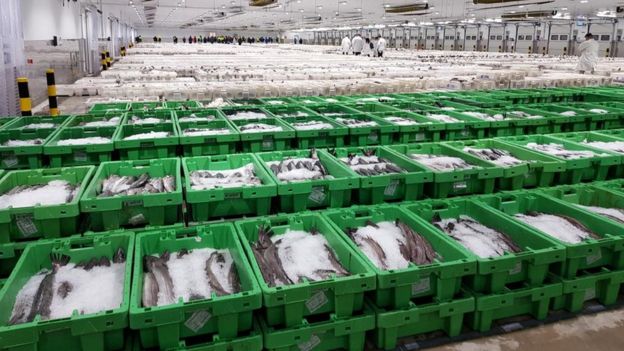
The Aberdeenshire town of Peterhead is Europe's largest white fish port, where a new state-of-the art market opened earlier this year.
 PETERHEAD PORT AUTHORITY
It handles tens of millions of pounds worth of fish, including cod and haddock, annually.
Speaking to BBC Scotland at Peterhead fish market, where more than 5,000 boxes of fish were landed on Thursday morning, trader Gary Mitchell said the industry feared for the future.
He said: "The fishermen are devastated. We don't know what's going to happen. We are being sold down the river once again.
"We just want clarity."
- Tory MP urges Mundell to quit over EU deal
- Reaction as ministers resign
- Reality Check: What does the draft agreement reveal?
- A guide to where we are with Brexit
Skipper Robert West said: "It is frustrating, but we have to deal with that all the time.
"We've had so much rubbish to put up with over the years, it's just normal."
The Scottish Fishermen's Federation (SFF) was formed in 1973, with the aim of protecting collective interests.
As details of the Brexit deal emerged on Tuesday evening, it voiced concerns about a link between access for EU vessels to UK waters and tariff-free access for UK seafood suppliers to the EU market.
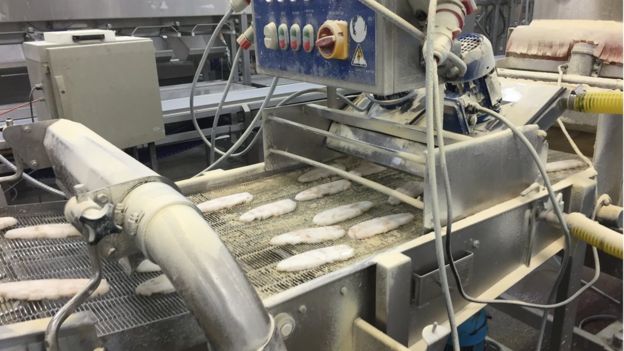
Chief executive Bertie Armstrong said: "The industry's priority has always been taking back control of decision-making over who catches what, where and when in our waters, so that we can end once and for all the grossly unfair situation where 60% of our stocks are taken, gratis, by boats from other EU nations.
"That would mean the UK becoming a fully independent coastal state with its own seat at all the relevant international fisheries negotiations from December 2020, and regaining its proud status as one of the world's major fishing nations. Negotiations over trade terms for seafood products would follow on from this.
"Any linkage between access and trade contravenes all international norms and practice and is simply unacceptable in principle."
Speaking on the BBC's Good Morning Scotland programme on Wednesday, Mr Armstrong said: "Yesterday we asked for clarification - we weren't preaching revolt, we were preaching clarification."
'The national good'
He said becoming an independent coastal state would allow the UK to decide who can access to its waters, and which can be fished.
"Once we become a coastal state we can stop giving away 60% of the seafood that exits our waters and start using that for the national good," he said.
Mr Armstrong added that a Scottish government's report had indicated that this would be worth more than £500m and 5,000 jobs.
"There is much to fight for. We need to get the best deal for Scottish fishing," he said.
Meanwhile, Alistair Sinclair, national co-ordinator of the Scottish Creel Fishermen's Federation (SCFF), said his industry relied on the smooth transportation of live shellfish into Europe.
He said there would still be "huge uncertainty" until they received clarification that this would continue.
Mr Mundell said after the Cabinet meeting on Tuesday that he was "content" with the Brexit deal.
He said he believed it meant the UK was leaving the CFP at the end of 2020, becoming an independent coastal state.
Mrs May told Banff and Buchan MP David Duguid on Thursday that attempts to link access to fishing waters to the trade aspect of negotiations would not be accepted.
Brexit: Scottish fishing industry calls for clarity
By Hyan Furtado
 AFP
AFP
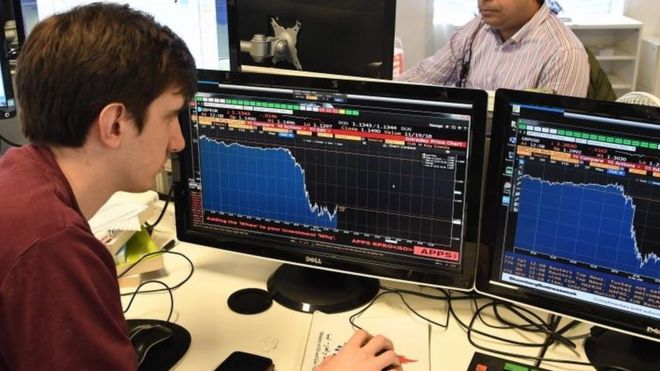
The pound and shares in housebuilders and banks have fallen sharply after cabinet ministers Dominic Raab and Esther McVey quit over Prime Minister Theresa May's draft Brexit deal.
Royal Bank of Scotland sank 9%, with 7% falls for Persimmon, Taylor Wimpey and Barratt Developments.
Sterling fell 1.7% against the dollar and 1.9% against the euro.
The FTSE 100 index closed little moved, but the FTSE 250, which mainly comprises UK-focused firms, fell 1.6%.
Capita topped the fallers in the FTSE 250, plunging 14%, with Countryside Properties down 9%.
Why have shares tumbled?
Shares in companies that do most or all of their business in the UK reflected the continued political uncertainty, as members of the Conservative Party and opposition politicians voiced their scepticism over the draft deal.
"The market has taken a big red pen to stocks which are heavily exposed to the UK economy like the banks, retailers and housebuilders," said Laith Khalaf at Hargreaves Lansdown.
"These sectors were already under pressure, but the potential for an orderly Brexit to unravel in the next few days is causing further distress to be manifested in share prices."
BBC business editor Simon Jack said: "The odds of a general election have just gone up and that means the possibility of a Corbyn government must have increased as well.
"Markets don't like the prospect of that because of Labour's intention to raise taxes on companies and nationalise large sections of the economy."
The higher chances of an election was one of the reasons behind RBS' steep fall, as the Labour Party has said it would nationalise the lender. However, shares in other banks also fell, as investors considered the threat to the economy and therefore to banks' balance sheets if the UK were to leave the EU without a deal.
What's happened to the pound?


Sterling ended the day in London at under $1.28 against the dollar after a turbulent day's trading.
Initially on Wednesday, when Theresa May announced she had secured cabinet backing for the draft Brexit agreement with Brussels, the pound recovered earlier lost ground. But by Thursday morning it was already wavering.
A string of ministerial resignations led by Brexit Secretary Dominic Raab and Work and Pensions Secretary Esther McVey, undermined confidence in the pound further as market observers deemed the chances of a disorderly Brexit had risen.
Pound vs US dollar
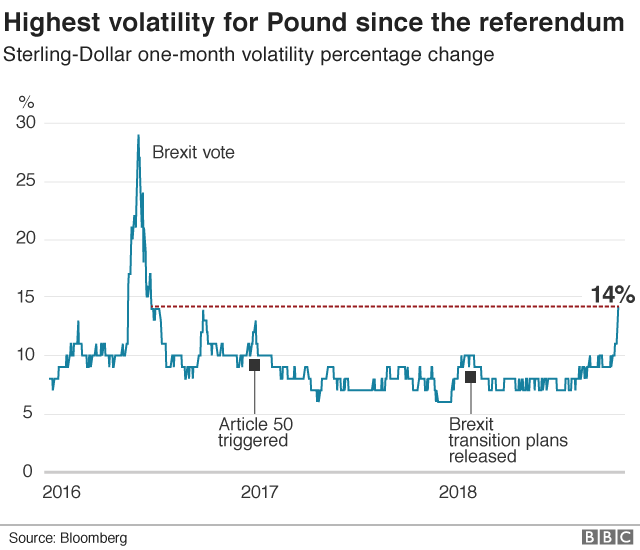
How has Brexit affected the pound's volatility?
The Brexit process has been punctuated by big movements in the pound's relationship with the dollar, something which can lead to big gains or losses for investors.
In the run-up to, and immediate aftermath of the Brexit referendum on 23 June 2016, for example, the pound hit a peak of volatility against the dollar.
And as the graphic below shows, the events surrounding Wednesday's draft agreement has triggered the greatest volatility for sterling since the referendum.
What do the currency strategists say?
Jane Foley at Rabobank said the pound's plunge was "firmly tied" to the perception that Mrs May will have difficulty in pushing the Brexit plan through Parliament.
She said the resignations had increased speculation that the prime minister would face a no-confidence vote, something that would weigh heavily on the pound: "Any turn of events that could raise the risk of a general election would also punish the pound, given the risk of a market-unfriendly far-left government."
Chris Turner at ING said Mr Raab's resignation had increased the chances of a leadership challenge and a no-deal Brexit.
He said the pound "could fall another 3-4% unless the threat of a leadership election is quashed or there are clearer signs that the withdrawal agreement can garner more support in parliament".
What does business think of the agreement?
Organisations that speak on behalf of business like the Confederation of British Industry welcomed the draft deal, because it offered the prospect of a smooth path towards Brexit.
The CBI described the agreement as a "compromise, including for business" but was happy that it represented a "step back from the cliff-edge".
The agreement includes a 21-month transition period, during which time the UK will negotiate new trade terms with the EU. The UK would have a unilateral right to extend that transition period, which was described as "very positive for business" by James Stewart, head of Brexit at KPMG.
Northern Ireland also has the guarantee of a "friction-free" customs border with the Republic of Ireland.
CBI Director-general Carolyn Fairbairn told the BBC: "There is a possible path to frictionless trade now in terms of negotiating the final deal. I don't think anyone thinks the transition or the backstop is the answer, so this has to be used as a route to a final deal with frictionless trade and access for services."
 GETTY IMAGES
So is everyone happy?
Of course not.
Pro-Brexit economist Gerard Lyons, chief economic strategist at Netwealth Investment and former chief economic adviser to Boris Johnson while he was Mayor of London, says the draft withdrawal deal is not something to cheer about.
"Whilst it has avoided the cliff edge, I think it's important we don't bury our heads in the sands here and view this as a 'good' deal - this is still disappointing," he said.
Those who had hoped the draft deal would supply some reassurance will also be disappointed as Theresa May wrestles with critics and struggles to unite enough MPs behind her plan.
Pound and UK shares hit by Brexit turmoil
By Hyan Furtado
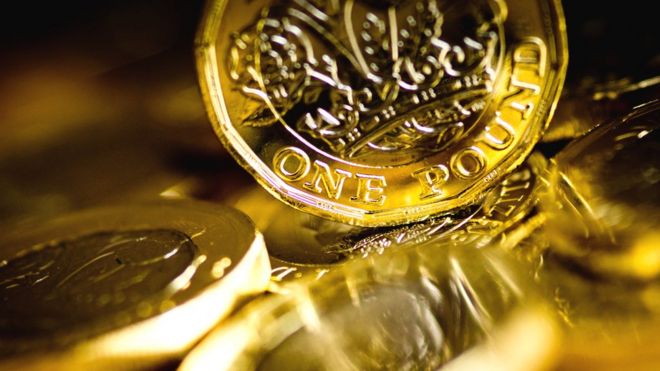 The pound has rebounded in afternoon trading in response to a report that the main elements of a Brexit treaty text are ready to present to the UK cabinet on Tuesday.
Sterling regained some ground after a Financial Times report cited the EU's main Brexit negotiator, Michel Barnier.
The pound turned positive against the euro, up 0.17% on the day at €1.1466.
Against the dollar, it recovered partially to stand 0.43% lower at $1.2918.
Mrs May is trying to rally support among cabinet ministers for her Brexit proposal in time for a hoped-for summit in Brussels later this month.
British Pound against US Dollar

The pound sagged in morning trading amid indications that her efforts had been delayed by increasing disarray in her cabinet over the issue.
On Friday, Transport Minister Jo Johnson became the latest government figure to quit his post over Brexit, arguing that UK was "on the brink of the greatest crisis" since World War Two.
- Ministers 'voiced Brexit plan doubts in July'
- Why May's Brexit deal may be impossible
- Brexit: All you need to know
Simon Derrick, head of currency research at Bank of New York Mellon, told the BBC that the pound's weakness against the dollar was "obviously related to the uncertainty over the weekend", but added: "At least half of it is actually about dollar strength and the expectation that the Federal Reserve will hike interest rates in December."
The resurgent dollar also hit the euro, down 0.6% against the greenback on Monday to $1.1265, having earlier touched a 17-month low.
Monex Europe analyst Bart Hordijk blamed the euro's weakness on "the four apocalyptic horsemen" of "Brexit, Italy, slower growth and a cautious European Central Bank".
He forecast that the euro could fall further against the dollar.
"Signs are certainly dire for the euro and a drastic change of monetary policy signalling, the Italian budget stance, macroeconomic prospects, or Brexit is what the currency needs now to turn this momentum around," he said.
Volatile pound regains some ground
By Hyan Furtado
Assinar:
Postagens (Atom)