President Trump's imposition of hefty tariffs on imports in a bid to protect American jobs, which has sparked a trade war with China, has put protectionism back on the global agenda this year.
That has prompted institutions that champion free trade to warn that higher duties and other barriers to free trade could have devastating consequences for the global economy.
Roberto Azevedo, head of the World Trade Organization, says trade barriers that keep foreign rivals out will encourage less competitive industries to produce more.
He knows firsthand what protectionism can - or cannot - do.
Mr Azevedo hails from Brazil, which for decades had some of the world's highest trade barriers despite being a commodities-exporting powerhouse and the world's ninth largest economy.
Although Brazil has started to open up its economy, it is still towards the bottom of the latest "trade freedom" index from the Heritage Foundation.
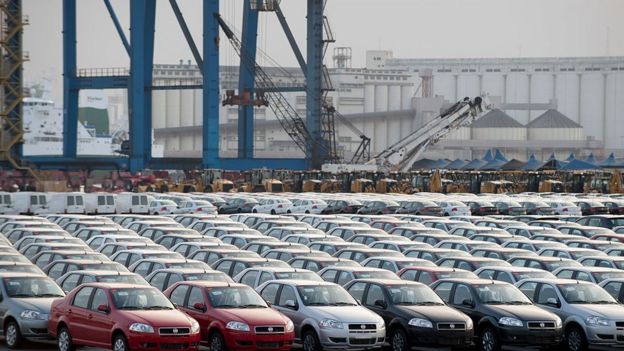
Fiat cars at the port of Santos in BrazilImage copyrightGETTY IMAGES
Image captionFiat opened a huge factory in Betim, Minas Gerais state, in 1973 and exports some vehicles from the port of Santos
Latin America has long been a fan of the "infant industry" argument for protectionism, which says tariffs foster the growth of national champions that would otherwise be crushed by foreign competition.
Much of modern Brazil was built with the help of protectionist policies. Since the 1950s, trade barriers and government subsidies were used to force major carmakers including Volkswagen, Ford, Fiat and Mercedes to set up factories in the country.
Many uncompetitive industries - from textiles to computers - were able to flourish due to trade policies that made foreign goods too expensive to import.
It was not until the early 1990s that Brazil started opening up to the world - but protectionism remains an important ingredient in forcing foreign players to manufacture locally.

Tariffs on imported trucks or buses amount to 132% of the final price, according to one study in 2014. The price of an Apple iPhone in Brazil is on average 50% more than in the US.
The best way - sometimes the only way - to sell to Brazil's 200 million consumers is to set up a local factory and become a "national" player.
While free trade has become something of a mantra in recent years, some question its benefit to emerging economies.

The country built on trade barriers

President Trump's imposition of hefty tariffs on imports in a bid to protect American jobs, which has sparked a trade war with China, has put protectionism back on the global agenda this year.
That has prompted institutions that champion free trade to warn that higher duties and other barriers to free trade could have devastating consequences for the global economy.
Roberto Azevedo, head of the World Trade Organization, says trade barriers that keep foreign rivals out will encourage less competitive industries to produce more.
He knows firsthand what protectionism can - or cannot - do.
Mr Azevedo hails from Brazil, which for decades had some of the world's highest trade barriers despite being a commodities-exporting powerhouse and the world's ninth largest economy.
Although Brazil has started to open up its economy, it is still towards the bottom of the latest "trade freedom" index from the Heritage Foundation.
Fiat cars at the port of Santos in BrazilImage copyrightGETTY IMAGES
Image captionFiat opened a huge factory in Betim, Minas Gerais state, in 1973 and exports some vehicles from the port of Santos
Latin America has long been a fan of the "infant industry" argument for protectionism, which says tariffs foster the growth of national champions that would otherwise be crushed by foreign competition.
Much of modern Brazil was built with the help of protectionist policies. Since the 1950s, trade barriers and government subsidies were used to force major carmakers including Volkswagen, Ford, Fiat and Mercedes to set up factories in the country.
Many uncompetitive industries - from textiles to computers - were able to flourish due to trade policies that made foreign goods too expensive to import.
It was not until the early 1990s that Brazil started opening up to the world - but protectionism remains an important ingredient in forcing foreign players to manufacture locally.

Tariffs on imported trucks or buses amount to 132% of the final price, according to one study in 2014. The price of an Apple iPhone in Brazil is on average 50% more than in the US.
The best way - sometimes the only way - to sell to Brazil's 200 million consumers is to set up a local factory and become a "national" player.
While free trade has become something of a mantra in recent years, some question its benefit to emerging economies.

Nenhum comentário:

Postar um comentário